Monday, December 3, 2012

Film Trailer Review

21 and Over Documentary Review

Link: http://trailers.apple.com/trailers/independent/21andover/


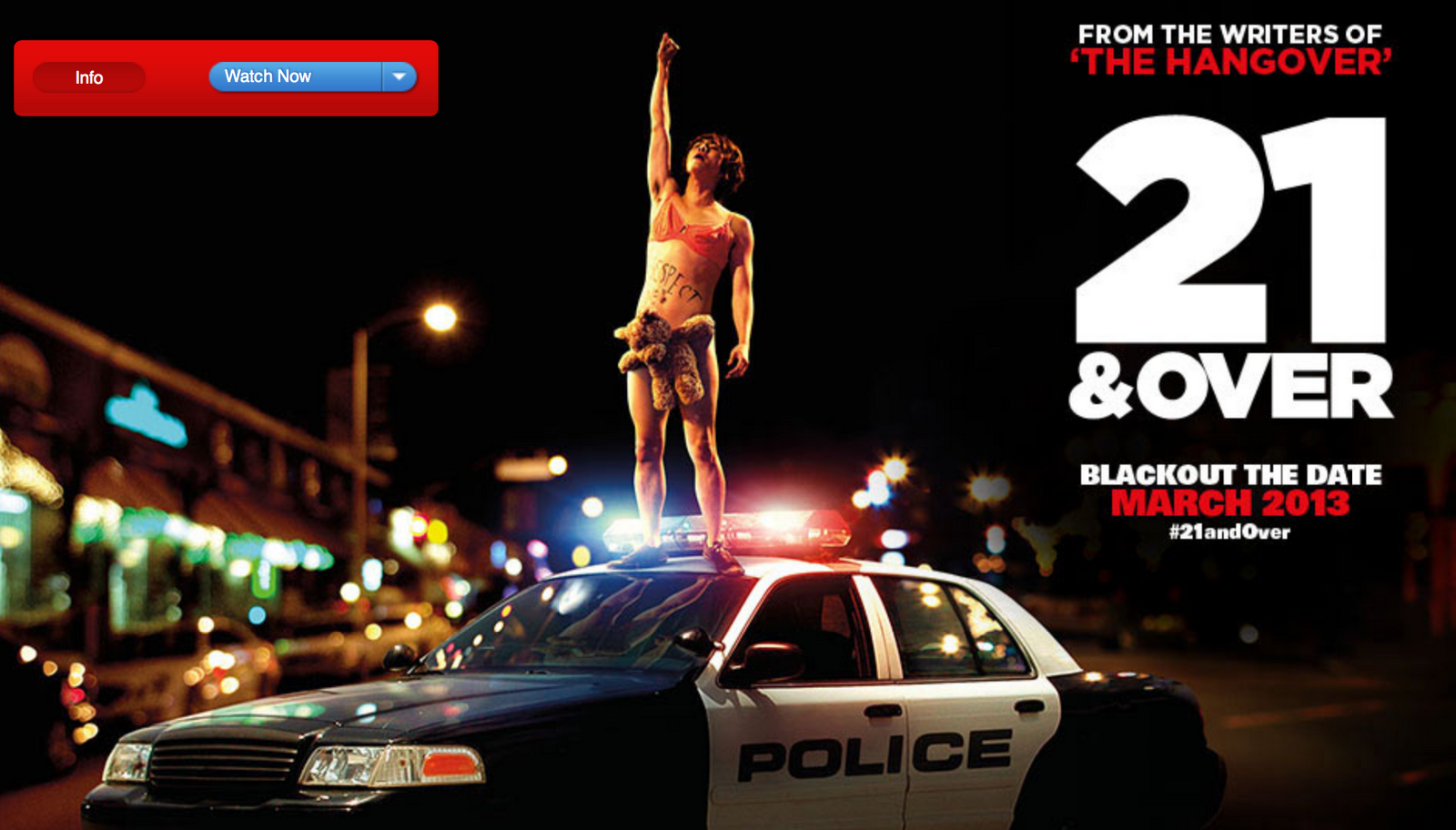
I watched a film trailer for a movie called 21 and Over which is coming soon to theaters. The narrative involves a college student whose father has arranged for a mandatory job interview at a business firm the next day. The trailer begins with a chase sequence and then the rest of it tells the story of what happened 13 hours earlier. The guy, named Jeff Chang, whose buddies surprise him by coming over the morning of his 21st birthday. The dad tells him that he must sleep well and be rested the following morning and not to embarrass him. This causes the barrier which will become the conflict for the rest of the film. The friends convince him to have a beer with them and this turns into a Hangover-like plot sequence. The protagonist is finally a man on this birthday and his friends want to make sure they celebrate correctly. They have an entire journey, filled with girls, drinks, cars, and buffalo not to mention tons of chaos and trouble-making in the process. The image above shows the catastrophe caused by this adventure.   


The Mise En Scene aspect of the shots of the trailer are very interesting. The shots are very well thought out and the things inside them help the overall flow of the movie. An example is this screenshot of the film above. It shows Jeff Chang being carried by his two friends, Casey and Miller. They have just experienced the adventures in a nightclub and have partied really hard. Jeff throw up and ends up unconscious by the end of it. Now his friends must find a way to get him home but they don't know where he lives. This rising action helps to propel the plot. The shot shows the entrance to the club and the neon signs on the window. It also shows that it has gotten dark since the time they entered the bar. The streets are empty and the darkness is a reference or indication of their situation because the characters face many challenges at this point. There is also a raccoon crossing the road which shows this emptiness and lack of resources to find a way home.    


The cinematography of the trailer is brilliantly done. The camera movements in the film trailer are very fast paced and this causes a lot of suspense and the feeling of adventure throughout it. The cinematographer uses panning in this clip which shows Jeff Chang running through his college campus naked with th exception of a bra and a teddy bear taped to where his private male parts are to be found. There is great acting and the man has a priceless expression on his face while he is running around like a crazy man yelling “Free OJ”. The location is perfect because they use an actual college campus. There are students walking around and there is lighting that is to the left and right of the actor in this shot. The light to the left, probably a filaments or LED light is used to show the actors body and this causes shadows as well. to the right there is use of a practical light, being the lampposts on the campus where there is no need to add more intentional lights. There is no use of the depth of field other than the walkway and changes of focus aren’t used in this particular shot but are in other parts of the trailer. The cinematographer uses primarily a wide angle lens for the majority of his shots.

The edit of the trailer is extremely professional. It is a Hollywood-made movie so this is expected. The events are linked together perfectly by dialogue, music, and titles. The shots start and end at the perfect timings, music is changed and stopped and the actions are also conducted by the tone in music. The dialogue from the actual film is used to show what the characters think and do and this tells the basic story or narrative. There are also sound effects used when funny things happen such as the strict and controlling father of Jeff Chang beats the children in his household so they leave. Every single part of the trailer is precisely edited.


The sound design of this piece was very cool. It was action packet itself and very intense which helped to show the true nature of the film. This was used in the bar and clubbing scenes where the characters go wild and crazy and learn how to live a little because the protagonist is finally 21. The crowd in this shot is heard screaming and cheering because the boys, or men I should say, have just taken shots and won a game of intense beer pong against another group. Also, the tone changes of the film are very well conducted. The dialogue is so clear and perfect and when there is music and dialogue there are no problems with that either and it seems perfectly intertwined together.  

Wednesday, November 28, 2012

Documentary Pre Pro Concept

1. Purpose: (What is the message or intent of the piece?)

To inform and entertain the audience about the lives of former war
veterans.


2. Contacts: (Who do I need to speak to in order to get the information for my piece?)

Senior citizens at the retirement home I volunteer at. There are
numerous veterans who would be happy to share their journeys with me.


3. Interview Questions: (What do I want to focus on in the interview? At least 5 questions and avoid Yes/No questions.) (REMEMBER THAT WITHOUT STRONG CONTENT YOUR PIECE WILL FALL FLAT!!)

1. What is your name and can you tell me about the war you fought in or participated in?
2. Was it difficult to decide if you should/would/could go to war? If yes, explain the process of decision.
3. Did the experience benefit you in any way? If yes, how so?
4. How has this impacted your outlook on the world?
5. Would you do it again if you could? Why?

4.Shot List- What images do I need to make the visual part of the story work?
Interviews use mostly Close-ups, Waist shots, and B-roll. Background should
also be considered. Usually at least 5 to 10 different shots are combined for a
sophisticated piece.


I will have various shots of the location where I will film. The B
Roll will include various shots of the senior citizens in their everyday life
and this is where the viewer learns about their current lives. Next we go to an
interview, and possibly have images of theirs shown during the interview. This
will have many shots. Mostly I will use close-ups and wide shots. Since there
are members of a team/ troupe who fought in combat together at this home, I
will have a wide shot and close ups of both.  


5. General Flow: Describe the beginning, middle, and end of your segment. Include any narration you might include as well as graphics or interviews. (Try to imagine the piece playing in your head)

In the beginning of the segment we will be introduced by a narrator who will tell the audience the main objective of the film. He will introduce the home and its members. We will introduce the lives of the people in the B roll while the narrator tells us about them. Then we will have various interviews and interesting dialogue in the middle part of the segment. We will also continue with showing what their lives are like now in the present day between these interviews as a sort of refreshment topic so we do not have to see the same thing continuously. We will show pictures and visuals relating to what information and feedback we get from the interview questions we receive from the above question. The end will be all of the senior citizens together saying goodbye.

Production Schedule- Dates for interviews/b roll

Saturday
December 1. Sunday December 2 (one day for primarily b roll, the other for interviews and insight on the citizens lives at many points of their life)

Sunday, November 25, 2012

Documentary Review


Life in a Day Documentary Review


I watched a documentary called Life in a Day created by director Kevin MacDonald and producer Ridley Scott. This film compiles over 4,500 hours of amateur and professional video from hundreds if not thousands of people from 192 different countries. The entire film is based on a single day: July 24, 2010. The clips serve to highlight the numerous aspects of human life on the planet Earth.  We see insight of the daily lives of people around the world and this was particularly interesting to me as I found out much about the world we live in and how similar we all are to each other although we are so far apart from one another. This film does not argue for a position, or take a stand on a subject, but instead offers a unique perspective on life itself. It is edited beautifully to show how everyone is equal and similar as well. The film does not have one narrator, but various narrators and individuals talking about their experiences in life. I loved this documentary and this take on life was very interesting to see because it showed a genuine snapshot on life.    


This documentary makes use of countless locations, scenes, events, and interviews. The film makes choices about what material is to be introduced at what point in time. For example, the director chooses to divide the movie into sections that show different parts of the lives of people around the world. He emphasizes the categories by holding long shots (in this case, he used the longer clips submitted to him for the film) to show the backgrounds and journey of the individuals. Here, the filmmaker wants us to learn about a man from Korea who has spent the last nine years of his life traveling around the world on a single bicycle. He has traveled through over a hundred countries so far and is still on his adventure. The director shows this clip to inspire all of the viewers and to entertain us by revealing a character who has does tremendous things in his life. He hopes to inspire us to make the most out of life. This clip also combines a voiceover of the man, named Okhwan Yoon, who tells us his story and the commentary by the single narrator. This helps to add a more emotional aspect and form a connection with the audience. He wanted to learn about cultures around the world and took it upon himself to find out about them.  


   This documentary also uses some footage that has symbolic or metaphorical meaning that overpowers the literal meaning of it. The filmmaker is especially fond of close-ups dealing with hands. Hands are a symbol of life, and in this documentary we can see many types of life being introduced to the world. A specific example would be this image to the left. The clip was part of the first sort of segment in the entire film which was about waking up in the morning as well as birth which symbolize humanity through the ages. The other segments were about what the people interviewed love, what they care about, their jobs, and generally their everyday way of life and survival. This shot shows a baby duckling that, when juxtaposed with the hand, shows it is very small and vulnerable to any outside force of nature. The focus in the shot is centered on the beak and head and I think it was how intricate the body parts are. This also serves to portray the significance of life and how precious it truly is. This is one of the things we tend to forget about in life because we humans are so preoccupied with other things that we forget about the small, meaningful things such as birth to a new life form.  

This film is successful in recording a seemingly spontaneous dialogue interaction between a group of people. During transitions between video clips we can see and hear an African folk song that a group of women are singing while they work on creating some type of material for food it seems like. The wide angle shot was low to the ground which is very similar to the eye-level of the people and this shows how close to the ground they are. They are barefoot which can also show their type of lifestyle. This song helped to show unity and form a connection to the audience who is learning about life in various countries. The melody was really touching and this shot shows a desert environment which is very colorful and their clothing help to show their lives in this setting. The three African women sing in unison about something no one other than people of this region or culture would understand. But the director specifically chose this piece to highlight a topic that is present in every culture and tradition in every part of the world. Music is very important in everyday life. It helps us get through our struggles, makes us feel happy or any other emotion, sets a mood, and also helps us to pass time just as these beautiful women are doing here. This is very significant because everyone can relate to it and understand what is happening when this clip is shown.


Another clip of the film showed a newborn baby wrapped in a blanket inside of a hospital. The previous shots showed her parents and the excited look on their faces as they had just brought a new life into the world which is an amazing spectacle to watch and experience. The director uses these parents as well as the baby as participants in the subject matter of his documentary. His goal is to show various aspects of life, human or animal, and he succeeds with every ongoing clip. This one does just that. The baby is a visual representation of life itself and how unique and genuine it is. The baby, in my opinion, represents the benevolent nature of the young who have not yet been exposed to the bad aspects of our world. It also is generally the symbol for goodness and thriving and happiness. The shadows used this shot offer fall off on the babies face. The light from the left side is almost overpowering but it helps to show the goodness that birth offers. The small beanie the baby wears shows warmth and the small nature of the baby with his eyes closed show how precious it is. The focus is also just on the face. The composure of this shot is very nice and I like its simplicity as well as the message it conveys. The colors in the shot are very soft also and I really liked that because they influence the nature of the shot.


We can also see this image of a man talking about what he loves. When asked, the middle-aged Jamaican male told the interviewers that he loves his children and his wife as well as life itself. This is the third section in the film that actually lends us opportunities to really learn about the lives of people in the film. This is one of the few times we actually get to hear people talking. When we do see or hear it, the people portrayed in the clips have interesting accents that show where they are from. I believe the director does this intentionally with the dialogue so the audience can learn about where they come from. The people in these interviews are very revealing and they can teach us a lot about life. We learn that the an has faced many challenges and obstacles throughout his life and his perseverance and family is what has led him to survive. I really really enjoyed the colorful background in the shot and the lively nature of the man being interviewed. He seemed happy about being alive and was filled with joy when talking about the things that make his life worth living.


Another moment in the film I really liked was when we are introduced to a single father of a young Asian boy in the urban part of an Asian city. This clip actually has various movements because the dad continuously moves the camera from place to place as he and his child move while conducting their normal early morning rituals like brushing their teeth and saying good morning to their mother. It is conveyed through a photograph and shrine for the mother that she has previously died while the boy was very young. The camera is moved to a table pointing at the photograph and candles and incense for her. Then it shows the boy going back to bed. Throughout the clip, we see the life of the two characters. Their apartment is extremely messy and dirty and their house feels very cramped. There are toys all over the place and clothing laying all over the couch and hanging from the ceiling. The clip is also the only one in the entire film that is shot with a fisheye lens which captures many parts of their life. This was my favorite clip of the film and it was very emotional and insightful and I learned a lot about this particular part of these peoples lives which I enjoyed doing.  


A final clip I wanted to talk about was this shot of two girls in a village in a setting that we do not have much information about. It is just another clip that occurs quickly but I found some significance in it. We see a relationship between two young female characters,p probably sisters, sitting on a bench rocking back and forth. They have their feet in the water of a creek or river. The serene and calming setting is shown by the ripples in the water, the focus on the bench swing, the soft natural colors of the mud and trees in the background, and the lighting which is magnificent and natural from the sun. The two take some time away from their normal lives to enjoy and have some peace. They are enjoying themselves a lot because they are laughing. I really enjoyed this because it shows a bond between sisters and shows a beautiful part of life for the children and their innocence in the world.

I really loved watching this documentary on life. It was so inspiring, informing, entertaining, and creative. I learned a lot about people from various parts of the world and their daily activities which are very different from everyone else. But throughout the film, we see aspects of human life and interaction that is similar no matter where you are. We as humans have a unique bond and although we are separated by thousands of miles, we are still very equal. This film has opened my eyes to the many aspects of life around the world, some of the conditions people live through to survive, their everyday work habits and rituals, and how they live in general from the time they wake up to the time they go to bed. I liked every part of the film and I can honestly say this was the best documentary i've ever seen and I highly recommend it to anyone reading this.    


Thursday, October 4, 2012

Formalism vs Realism

Soviet Montage and Formalism

Formalism is a director's way of styling his film. It is not realistic, but in turn, somewhat like the opposite. Formalism is the visual representation of a director’s own perspective that came from within the artist and not anything portrayed in the actual world we live in. Every aspect has an artistic style and design that comes directly from the directors imagination. very easy to create a formal composition of the works. Usually, these concepts are usually recognizable as unreal and not occurring in our world. They use a wide variety of shots and also have quick cuts and sequences to help show what is happening in the film. There are many types of focus and shots which help to isolate an object or character so all the attention is on that only. Pudovkin's concept of constructive editing played a role as he believed it ruined the way people were to perceive and have their own opinion on film. He used close ups because he thought everything else was too realistic compared to it. The Kuleshov effect was using many images to convey a meaning. This is shown in today’s films as different people have many opinions on different things so when this is used, it gives the viewer a believable aspect. The Eisenstein Montage is the idea that montage could make an idea deeper than what is portrayed. This works in the “Odessa Step” sequence because it shows the juxtaposition and manipulates the viewers perception.  

Andre Bazin and Realism


Realism is using film to represent reality. showing or revealing the world and connecting it to the audience point of view. There are usually wide angles and long shot sequences in these types of films. The long duration of these sequences help to show real-life aspects to the shot to make it more realistic. As a result, there are a minimal variety of shots used. There are also minimal editing techniques used to preserve the integrity and world-like qualities that is being portrayed. The use of panning and tilting is also used. The use of deep focus is also critical because instead of focusing on a specific action or character in the shot, everyone and everything is in focus so that the viewer can notice all of the things happening at once which is similar to our own perspective through our eyes. Andre Bazin’s frustrations with Classical and Formalistic film making include the obstruction of a realistic point of view by using excessive editing, shots, and focus. He strived for a more unmanipulated approach in his film making. Realist filmmakers strived for the most realistic aspect they could include worldly shots in their film to make it seem more so the audience can relate to its ideas.

Tuesday, October 2, 2012

Advanced Editing Notes


The two short films: the "Arrival of a Train" and "Damsel in Distress" highly relate to aspects of Realism, Classicism and Formalism.

There is a high contrast between camera work including the composition of shots, their angles, and the movement of the camera. In "Arrival of a Train", we see a lonnnng, continuous shot of a train that is arriving at the station, hence the name. This is entirely one sequence shot as it is a single recording of time. The angle is static and does not change at all within the scene and this provides for one viewpoint and angle and offers the viewer a single perspective on what is happening in the shot. The camera is not moved at all the only movement in the shot is the entire train as well as the reaction of the people waiting to get on the train that are standing in the side area. In the short "Damsel in Distress", however, we see the exact opposite. shots literally last a couple of seconds and this duration plays a large role in how we see the movie because of the rapidness of the succession of events. There is a lot of movement, a wide variety of angles, and the majority of the shots are composed very differently.

Also, the edits of the shots in the films are differentiated. In "Arrival of a Train", there is no edit, cut, or jump in action throughout the entire scene. The entire thing is completely realist. On the other hand,  "Damsel in Distress" is the opposite as it highlights the ideas portrayed in techniques for fast, quick cuts that are very short in duration. In this film, there are two conjoined plot lines and we see both perspectives of the conflict while the protagonist is trying to get to the tracks to save the woman and the womans conflict of being very close to dying. There are many edits in this film to show the rising tension and conflict among the characters and their relationship.  

There are many interesting characteristics of how the story is being told in both short films. I found it highly interesting how the second film "Damsel in Distress" was told because it has a series of shots selection, angles, composition, characters, conflicts, and the plot was really well-developed and easy to understand although the shots didn’t have very long durations or slow pacing. This intensity helped to show the plot in a more beneficial way. In "Arrival of a Train", however, everything except for the people and train seems to remain completely static. It is very boring and there is nothing to truly anticipate. We see one perspective because the camera and angle do not move and this restricts the viewer from any further information so it is more boring and less informative about everything else happening.

Thursday, September 27, 2012

Plot Outline - A Man Dying

Plot Outline: A man dying

SceneDramatic Intent
Have man get into a terrible car crash


Character: Man is panicking, entire life flashes before his eyes


While he is being transported out of the car all the way to the ambulance and hospital we see flashbacks


Setting is the open road, it is raining


Flashbacks are happy/sad/pivotal moments in his life, provide the backstory and relationships throughout life, quick cuts Flashback of childhood, family, and significant events in his life.


Cops at the scene, people screaming and crying, blurred out police and ambulance lights in the distance sound of peoples screams

Frequent cuts to medic reviving him


Final Reveal: It is revealed that the man was widely abused when he was young and he was trying to kill himself by drifting into the other lane while the rest of the story shows how he got there 


At the end we see that the man has been telling the story of his life through this, entire story was a flashback, also provides for the backstory
Portrays a man who is dying and reveals emotional characteristics

Flashbacks provide context and story of the mans life, a close perception of who he truly is


Setting helps to show backstory and how he arrived at this final point also through flashbacks and shots of the car crash and rain


Gloomy and depressing atmosphere with sad music, highlights mood of the story by setting the way we see the events occurring. Mood is extremely sad because the man is fatally injured and dying


Help the emotional aspect of the film because it brings out the feeling in the scene to show the sad aspect of his life, and now he is dying, shows depressing moments through relationships


Goal of the film is to save the man’s life is the present part of the film, while the flashbacks show his life story, Obstacle is the injury through this car crash

Show the realistic aspect by going to what is really happening. Reveal obstacle and goal because there is the motif of life and death

The rest of the story explains the events that led him to that point in time. This reveal of his suicide shows his phycological and emotional ideas about life and everything he has been through


We realize the entire thing has been a huge conflict and that the man is telling the story of his life and how he came to this moment for the future tense to show that he is now ok and still living, shows us what happens in the end and gives us backstory

Sunday, September 23, 2012

Characterization

Characterization Theme


The character I chose to talk about is Harry Potter from the movies based on JK Rowling’s extremely popular book series. in this case he is trying to achieve his goal of killed the Lord Voldemort in the final installment of the series called Harry Potter and the Deathly Hollows Part 2. Throughout the entire series, Harry (played by Daniel Radcliff) is characterized as a adventurous, intelligent, courageous, and benevolent character that takes it upon himself to defeat the evil Lord Voldemort who killed his parents and friends in the past movies and books. In this particular scene from the movie, Harry and Voldemort go at it in one of the final scenes and this is the crucial battle that determines who will win after all those years of fighting. The physical description of Harry is interesting in this shot. His body is positioned so he can use his magic and try to outdo and overpower the Dark Lord. This offensive body language adds to the depth of the picture and shows us that he is vulnerable in this position but is using all his strength to win. His raggedy clothes are a representation of his difficult journey and what he has gone through to be at this pivotal moment in his life. The only obstacle in this scene is Voldemort and his army which is opposed by Harry’s army which is composed mainly of students and teachers attending Hogwarts School of Witchcraft and Wizardry. In the end, Harry wins this battle. He has much help from everyone that cares about him and in this particular scene, he out powers the Lord and uses all of his strength and does whatever it takes to achieve his goal in elimination evil from both this magical realm and the real world.